Of Mooncursers and other Spun Yarns

Of Mooncursers and other Spun Yarns
Click the link below and visit my Book site

Thursday, December 7, 2006

What was to do in Dundalk

Being a young man or a young women in Dundalk must have been a fine time. There was plenty to do if you were over twenty-one. There were night clubs all around town but none in town. There was plenty of drinking to be sure but dancing was really what it was all about. This was the time of the big band and every night club in the Dundalk area of any size had a six to nine piece band. Some smaller places had a three piece group. Even the smallest joint in town had a piano and a player. There was good music and large crowds at Dovies night club at the corner of Stansbury and Merritt Avenue. John Deluca's Place in St Helena packed them in. Down Dundalk Ave. was Peanut Hall. Peanuts were free and the shells went on the floor till they were several inches thick. Right around the corner from there was the Woodland Inn,. Friday, Saturday and Wednesday nights were all a big time. When people went out back then, they were dressed to the nines as the saying goes.

A fellow would say “What'ya wanna do tonight baby,” and the answer was sure to be “Lets go dancing.”

You could drive out to Josenhans corner in Essex and they had free steamed crabs all you could eat. All you had to do was buy beer. Crabs were so cheap you couldn't buy less than a bushel I think about 25 cents was the price.
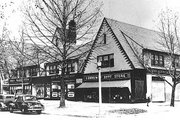
So getting back to Dundalk, what did us little kids do? Well out on Robinwood Rd. we often walked to Dundalk with our mothers, down Midland Rd. to Sollers Point Rd. and across the Railroad tracks to Dunman Way, past Dundalk Elementary and the junior high school on Play field St., on across the park, past the Bandstand and over to the Community Department Store.

Mr. Sax the owner was a wise man. He knew the taste of most of his customers. I remember him saying to my Mom, “Mrs. Pollard, look at the sewing in that dress I know that won't measure up to your needs.” “Now look at this it's the kind of thing you like and look how it is stitched.”

He would open the dress so the seems could be seen. My mother would touch the threads and say, “Yes, I believe your right Mr Sax, but the price....”

“Mrs. Pollard, consider this, I and some other shop owners in the city bought a case of these so you won't have to walk down the street and see yourself coming.” 'There is only one of these in Dundalk and because we bought a case, I can let you have it at $ 2.39.'

She could squeeze a dollar until the Eagle hollered but sometimes she bought it.

About all my clothes came from there as well as my “Poll Parrot” shoes. When after a time they were relegated to being play shoes my father would rivet harness leather on the toes. Because I was prone to kicking tin cans as I walked and would ruin my shoes in a short time.

If my father needed a pair of pants or a shirt we all went in the car. Sometimes he and I would go off and leave the women, He would go into Lillac's Pharmacy to buy cigarettes they sold them loose two for a penny. Dad would buy three. He made them last, he would take a few puffs and butt it sticking it in his shirt pocket. His shirt pockets were all black inside showing through where the ashes had stained the inside. He also kept a corn cob pipe at work and he would smoke the buts in that.

Dr. Lillac always had a older teenage girl or boy working at the soda fountain. If the father or mother of a house hold came in to buy at the fountain he always came out to talk. Teenage boys and girls setting in the booths drank Vanilla, Chocolate, or phosphate Cokes. Mr. Lillac liked talking to the kids and would lean against the booths like a kid while talking. Whether he was friendly or not the kids behaved in his store.
Sometimes Dad would give me a few pennies to go to McKevers delicatessen where I could get two pieces of candy for a penny. Then I'd put another penny on the counter and fish around in the pickle barrel for the biggest pickle I could find. It's hard to say how many hairy arms had been in that barrel up to the elbow in saltbrine, before all the pickles were gone? I saved the other penny to put toward a “Captain Midnight Secret Decoder Ring” even though I couldn't spell yet. While I was at McKevers, Dad would be in Sheff's Stag Bar having a beer.
My brother Charlie almost never went with us. He was in high school and I'm sure was loathe to be seen with his Mother and Father. Besides he was an ice man and that kept him plenty busy in the summer. They also moved furniture during the winter using the ice trucks to haul it around. A fellow could build up a muscle or two doing that.
We always went to Knoop's Hardware and Dad would buy some needed thing. I liked that place. Mr. Knoop bought nails that us kids pulled out of boards and straightened with a hammer and then he resold them at half the price of new ones. My first batch of nails was rejected by Mr Knoop. I took them home and worked on them some more. He found them strait enough to sell and I had a nickel. That was a pretty fair income for a boy that hadn't even started to school yet. The boy that could get his nails straightest had a certain amount of respect from the rest of us. A few were darn near perfect. I think they might have had a roller to straighten them with.
There were a lot of other store's there along Shipping Place. There was a bank, a shoe shop, a couple dress shops and the Strand Bakery. The Police Station was there along with the Fire Department.. The place got to be a local hangout and there were a few cracks made toward women shoppers passing by that started a scandal. Somehow it was all worked out to everybody's satisfaction and life went on.
The big thing in town was the Strand Theater and it was the only one for a long time. Sunday night with standing room only the balcony and side isles full the temperature would skyrocket. Air conditioning had yet to arrive.

Tuesday, December 5, 2006

Goin' over Dundalk


We in Dundalk Farms weren't quite "Dundalkers", at least in our own minds anyway. We all talked about walking over Dundalk and that's what we did and that's where you did things. You shopped, went to the movies, went to Church, and caught the Red Rocket (otherwise known as the #26 street car) to Baltimore. Boy! There could be a whole book written about riding the Red Rocket.
We became "Dundalkers" when we started to school. We went to Dundalk Elementary school and we could walk there. If you lived more than a mile away you had to ride a bus unless you got thrown off, which boys were prone to do.
I remember one troublesome boy having to walk from very near Old North Point road. That had to be four miles. He was a hardheaded Dutchman. The Teacher Mrs. Merritt offered him a ride home because he had a blister as big as a quarter on his heel. He replied, "The Principal said walk." The boy stood up and said, "If you'll give me one of them Band-aids ma'am I'll walk. I ain't lettin' no school off that easy." Those who rode a bus could not claim to be from Dundalk. They were from Holabird or some other nearby town or area and most were proud of it too. There was a fair amount of rivalry among the different communities. Most of it came from baseball, there being a ball park in every little town. Sandlot ball was a big deal in those days. Dundalk had several beautiful red clay tennis courts but only girls played. We boys thought it was a sissy game. For boys the big thing was shooting marbles. Now shooting “hootles” always led to fighting so we all got pretty good at that as well.
St Helena and Dundalk were called (a little tongue in cheek) twin cities. There was a restaurant on Dundalk avenue named the Twin Cities Restaurant. People hung out there from both sides of the street and with local rivalries being what they are there was often a doggone good fist fight to be had there. Pain and suffering being not among my favorite interests I always endeavored to be a nonparticipant. Stand aside always begets pain. So standing still makes a fellow a target and a non-moving one at that and there you go right in the middle of it. Good old Baltimore you'd get arrested for spitting on the sidewalk but you could fight up and down the streets and alleys all you wanted as long as you didn't spit or cuss. Local people didn't curse anyway—they cussed.


I'll do one more post describing Dundalk back in those days and then we will write a book.
By-the-way anybody know the fellow in the picture? It was taken at the old Logan air field there, where Logan village is now. My father took the picture in the late 1930's. I've had it all my life, don't know who it is but can't bring myself to toss it. Doug

Sunday, December 3, 2006

Kimmels Mountain

In Dundalk there was an airport, Logan Field, that had been a military airport during World War One. It was a place where many Sunday afternoons were spent watching airplanes take off and land. The military training planes were busy seven days a week. They were painted blue and yellow and stood out from the commercial and private planes that set all around the field. It was here that my Father put me on a Ford Tri-motor passenger plane for a tour around Baltimore for about 20 minutes. He would not put out the two dollars it would have cost for himself to go, but they had a couple empty seats and the Pilot let me go for a quarter. Two dollars was a lot of money.

The field was too small for the new airliners that were now in service and these new DC 3 airliners were struggling to take off and to clear the nearby houses that were encroaching on its glide path and at the end of the runways.

There was a terminal where the China Clippers were landing in the Baltimore harbor. These huge seaplanes were carrying passengers back and fourth from South America, the Caribbean and Florida. Baltimore thought this was the future of air travel, and so, the city decided to build an airport in the harbor where DC3's could land as well as seaplanes. Kimmel's Mountain was the place to get the dirt to fill a section of the harbor for the airport. Kimmel's Mountain was a beautiful place. It was a huge stand of hardwood trees--oak, ash, gum and other trees with different nut bearing trees in the mix. Around its edges it had grown up in blackberries and raspberries, as well as strawberries and goose berries with an occasional wild cherry tree. During the summer, some of the local families would search there for the variety of berries and nuts. By Christmas every dining table in every house was filled with nuts. Paths criss-crossed through the woods and were a favorite place for family walks. The only danger there was that of walking up on unaware lovers. In the early 1930's they began digging up the hill and hauling it away by the dump truck load. They started on the other side of the hill from our house and for years they dug away at the hill. Early on, there were three huge shovels and maybe fifty dump trucks working. After awhile they were down to one really huge shovel. It was a true steam shovel with a shovel so big a full grown man could stand up inside of it. Two of its shovels would fill the biggest Mack "chain-drive" dump truck they had. The sight of that huge shovel digging only about a hundred and fifty yards a way was kind of frightening. I remember my sister Madge saying it scared her and how she hated that thing. It was kind of like a huge earth eating monster chomping ever closer day by day and there was no stopping it.

Steam shovels and dump trucks were all that filled mine and the other kids minds at that time. I got my bottom switched several times for sneaking away to go up and watch that shovel work. We all played steam shovel as small kids. We would squat down and use a tin can while pretending we were steam shovels digging in the dirt and making steam shovel noises all the while. A large coffee can, because of its size, could be traded for a cap pistol any time. We dug a hole at least 10 feet in diameter and 5 feet deep. We covered it up with a wooden roof a rug and a layer of dirt. My dog used it for a dog house, as it was warm in the winter and cool in the summer. On a hot day it was hard to get him to come out.

Kimmel's Mountain was actually a sand dune that had been left there about a hundred thousand years before when the Atlantic coast was along that area. In March or during a good thunderstorm the wind would pick up clouds of sand and blow them all over the neighborhood. I remember Mom stuffing rags under the door once in a storm. The front porch had an inch of sand on it and everything in the house a layer of dust.

Friday, December 1, 2006

Growing up Dundalk

Robinwood Rd. Dundalk, MD

As stated this will be the writing of a book If you follow along from day to day you will experience it as written. You will read it with bad punctuation, spelling and all it's other wart's and then you will see it as it is edited. You will see what I keep and what I throw away. You will be able to see it through to completion and then buy it from a print on demand publisher online. I expect this writing to take at least a year and maybe two. Know this! I am not a teacher and not only that I have almost no education. This would not be the way to write a book by almost anyone's standards. However it is my way so take my methods for what they're worth or don't take them at all. I would like to propose a toast to all of us and our completion of a book about Dundalk and it's folks. To "Dundalk and it's folks", it's success or failure.
These first posts will lay some groundwork by way of identifying some people, places and times and then we will begin the telling of a story. I have no idea what we will write but from experience I have every confidence it will all come together. Certainly not without numerous hitches.
The above picture is of The Pollard home place. My parents, Fred and Ruby, had four children Charlie, Dot, Madge, and Dougie (that's me). Charlie and I both had a lot of friends and the girls were beautiful so there was never a shortage of young men hanging around with rapidly beating hearts.
I'm only slightly kidding when I say I remember everything. I remember most everything. I was born on Robinwood Rd. in Dundalk Farms in 1934. My family had moved to Baltimore from Georgia in the 1920's so we weren't native Marylanders. I think they held Baltimore and it's people a little in awe. My father and older brother built our house as did most of the neighbors at the time. The neighboring fields were farmland grown over with broom straw. There were houses speckled here and there along gravel roads. Most houses were built on one acre lots of land with only a few having bought two acres.
At age two, I remember my diapers hanging on a makeshift clothesline which stretched from our pot bellied stove which supplied our heat to the chimney that was at the end of the four room house. I had asthma so I spent a fair amount of time lying on the wicker sofa where I could see everyone. I would catch a cold and do my death defying act of continuing to breath. I lay there a great deal of the time from December through March when I would perk up and make up for lost time.
Our house was under construction as were most of the homes on our road. We had sheet rock up on the interior walls with asphalt shingles on the outside the first winter. We walked on sub-floors covered with second hand carpets. A sudden gust of March wind would sometimes raise the carpets off the floor in some places. Sounds kind of hard nowadays but the world was slowly recovering from the depression and my father worked two days a week at a good job. We were better off than many.
Most of our neighbors built the same way my parents did. They would not borrow a nickle to build. They were all too well aware of what would happen if the depression got bad again. Any of them could be made to shudder by the mere mention of the word mortgage. Otts McClelland next door was a railroad fireman. He fired a steam Locomotive at Sparrows Point all night and worked on his house all day. Otto Walter, from across the street, was a tool and die maker at Glen L. Martin co., where they built airplanes. My father, Fred Pollard, was a machinist at Western Electric co., on Broning Highway. In those times a highly skilled tradesman who worked for a good company could afford to live in a neighborhood and rub elbows with Steel mill management and other executives.